Survey record
The sheets as written on site, transcribed without edit, with the head sheet in front.
Site surveys, condition reports and specifications · Christchurch, Dorset
AQUAVAIL LTD prepares site surveys, written condition reports and specification documents for property owners and the advisers acting for them. Every observation below carries its qualifying note in the margin beside it, so a finding and its limit are read together.
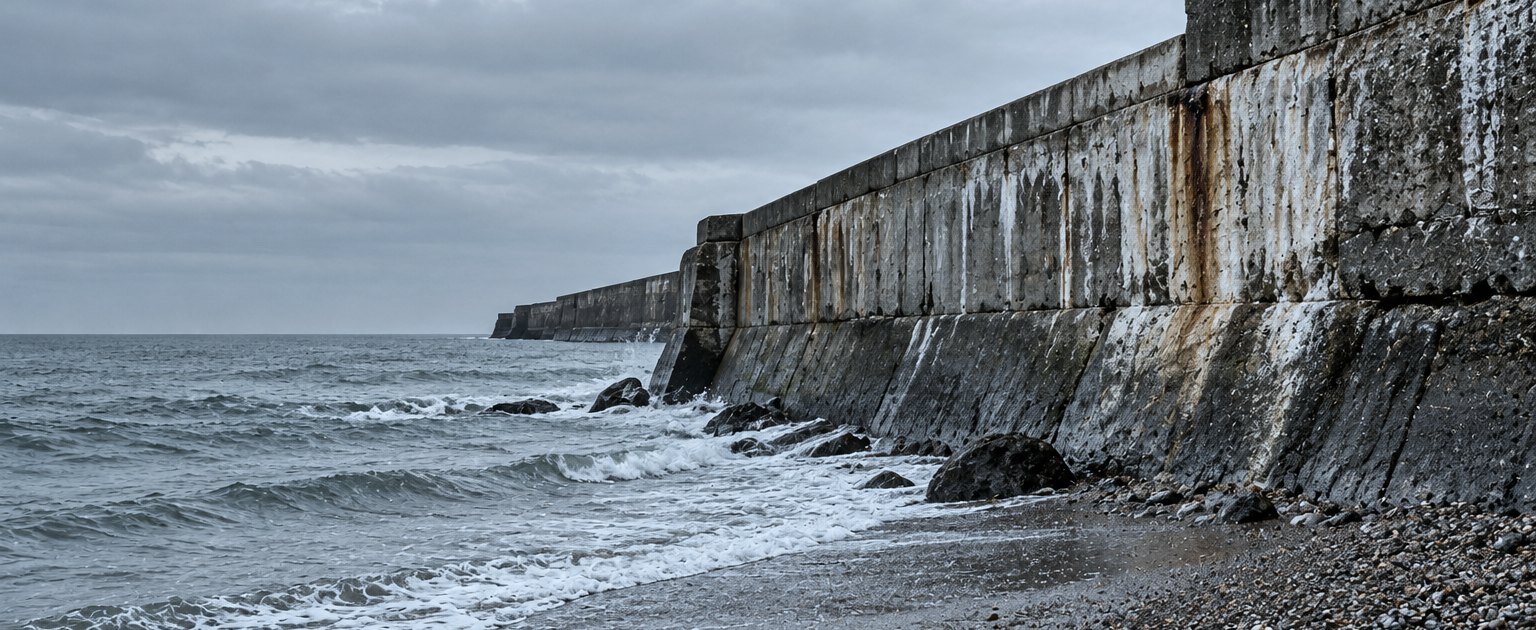
Band: editorial photograph of a sea wall elsewhere on the English coast. Not a site surveyed by this company.
Observation 01
A survey here begins at the water and works inland, because that is the order in which weather reaches a building. The first pass is a walk: the frontage is paced, reachable faces are reached, and the hour and the tide state are written at the head of the sheet.
Four properties are read on that walk, each recorded as a described condition rather than a score.
Observation 02
How many observation points a frontage takes at a chosen spacing, and what that costs in walking and in time. Arithmetic on the three figures entered, shown step by step. A guide for planning a walk.
Observation 03
The drawing below is the shape every coastal record is written against: the wall in profile, the beach falling away from its toe, and the observation points dropped onto the line with the level read at each one. It draws itself once, and the tide band washes across the foot.
Specimen chainages and levels. The drawing shows the form of the record; it is not a measurement of any site.
Observation 04
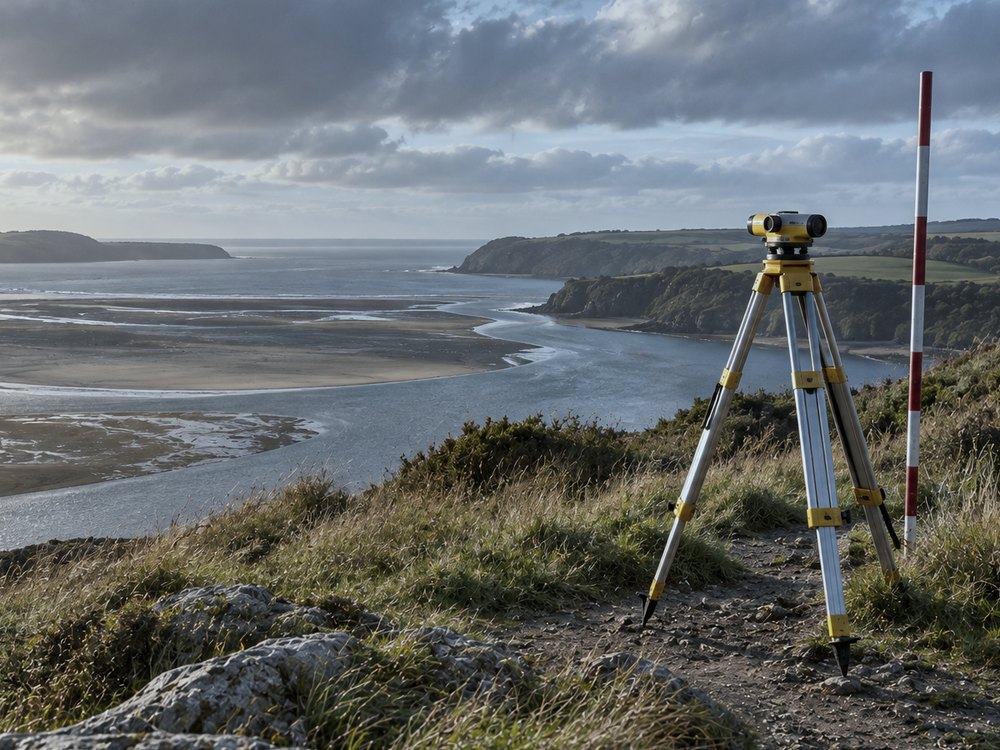
An instrument set above an estuary reads the same ground twice over one tide. The window is not the whole day: it is the part of it when the face is dry, the light is usable and the staff can be held still.
Observation 05
Observation 06
A condition is written as a sentence before it is written as a grade. The sentence names the element, the face, the defect and the extent reached; the grade follows as shorthand for it, never as a replacement.
Three grades are used. One: serviceable, with the evidence stated. Two: serviceable, with work identified and a period named. Three: work required for the element to go on doing its job. Each grade is dated, because a coastal face moves between visits.
Where an element was out of reach, the report states what was read instead, from where, and what would be needed to read it properly. That sentence is as much part of the record as the grades around it.
Observation 07

A report is useful only if the next one can be laid beside it. The record therefore keeps one order from first page to last, and the specification quotes observation numbers rather than restating them.
Observation 08
The sheets as written on site, transcribed without edit, with the head sheet in front.
One row per element: the sentence, the grade, the date and the extent reached.
What is to be done, in the order it is to be done, quoting the observation it answers.
Every drawing issued, with its scale, its datum, its revision and the date it was issued.
Observation 09
Every report carries the same five clauses on its last page. They state the reach of the work, so a reader coming to the document later knows what was looked at.
Observation 10
A finding and the limit it was read within are one statement. Printed apart, each of them says something the survey did not find.
It is printed at the head of every condition schedule this office issues, and it is the reason the notes on this page hang beside the observations rather than underneath them. Written enquiries about a survey, a condition report or a specification document go to enquiries@aquavail.work.